When a Chinese pelletizing line cannot hold pellet quality or output, the first thought is to replace it entirely. Himmash takes a different view: you do not need to replace all your equipment. The line is improved and upgraded: key units are replaced, and washing, degassing and filtration are rebuilt to achieve consistent product quality. Let’s look at which units to check first and how they are upgraded.
Where to start a line upgrade: symptoms and units
Before buying anything, link the line’s problems to specific units. Typical symptoms and what they point to:
| Symptom | Likely cause | What to upgrade |
|---|---|---|
| Gray pellets, dark specks, screen clogs quickly | poorly washed feedstock: sand, organic matter, labels | washing, melt filtration |
| Bubbles, voids, delamination in the pellets | moisture and gases in the melt | drying, vacuum degassing |
| Frequent stops for screen changes, pressure spikes | manual screen changes on contaminated feedstock | continuous slide-plate screen changer |
| Uneven pellet size, pellets sticking together | worn die plate and knives, wrong head type | pelletizing head, die plate, knives |
| Vibration and frequent repairs of the washer or centrifuge | unbalanced shafts and rotors, worn blades | new balanced shafts and rotors |
| Heat and noise in the thrust bearing area | axial load at the limit of the unit’s capacity | thrust bearing unit |
| High fresh water consumption, difficulties with wastewater discharge | no water recycling | closed-loop water treatment |
It makes sense to work in the direction of material flow: first washing, then degassing and filtration, then the mechanical parts. If you start from the end and install a good filter on poorly washed feedstock, the filter will work, but you will have to change screens far too often.
Washing: what to rebuild upstream of the extruder
Whatever is not washed out in the washing section has to be caught by the filter, or it ends up in the pellets. That is why washing should be checked first, before investing in the extrusion section.
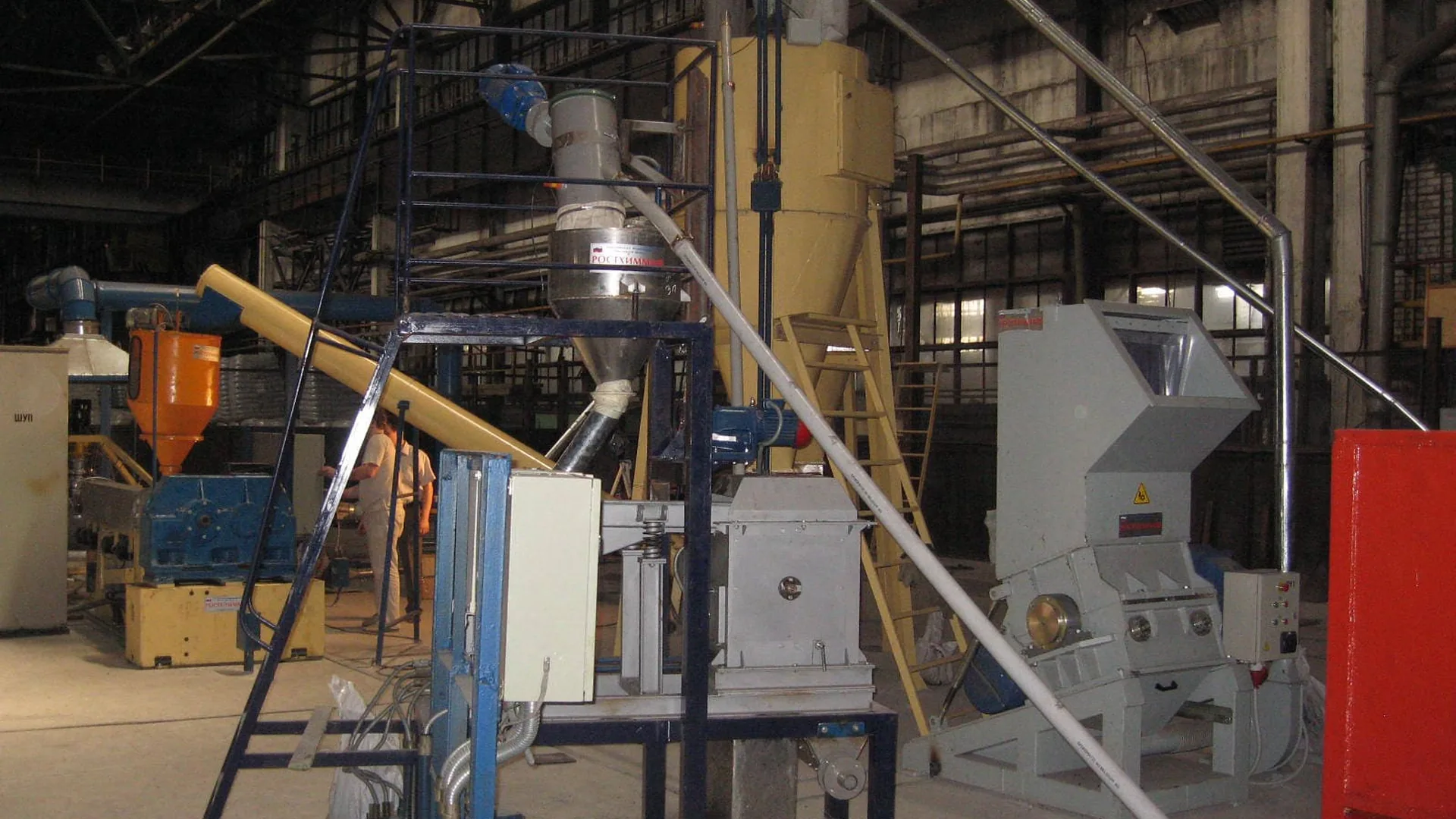
For heavily contaminated feedstock, washing is built in two stages. A flotation washer removes sand, stones and heavy contaminants: particles heavier than water settle to the bottom of the tank and are removed periodically. Then a rotor-type friction washer cleans the material with hot water and detergents by friction against the blades of a high-speed rotor. A centrifuge after washing reduces moisture to 3–5% and takes load off the dryer.
When rebuilding, it is important to match the fraction. Himmash friction washers and centrifuges accept film up to 50 mm, PP yarn up to 100 mm and thick-walled plastics up to 30 mm, and shredding is set up for these sizes.
Melt degassing, filtration and pelletizing
Vacuum degassing
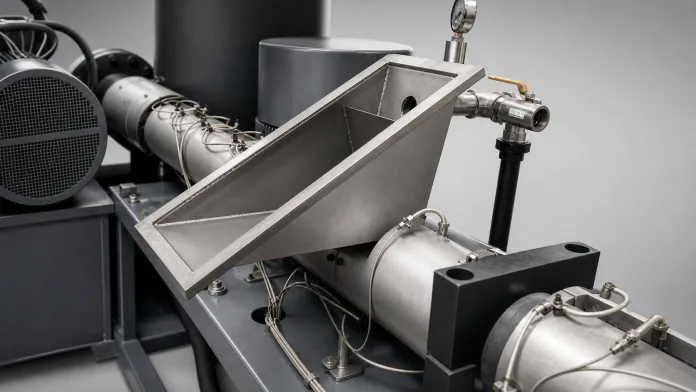
Moisture, gases and ink decomposition products left in the feedstock cause bubbles, moisture droplets and delamination in the pellets. If the extruder’s degassing zone runs without vacuum or the vacuum is insufficient, it is retrofitted with vacuum degassing. A chamber is located above the degassing zone; a vacuum pump evacuates it in a controlled way and removes moisture vapor, up to 5%. Pump power is 0.75 to 4 kW, and the unit occupies 1.5 m². The result is pellets without moisture droplets or delamination, with better tensile and break strength.
Continuous slide-plate screen changer
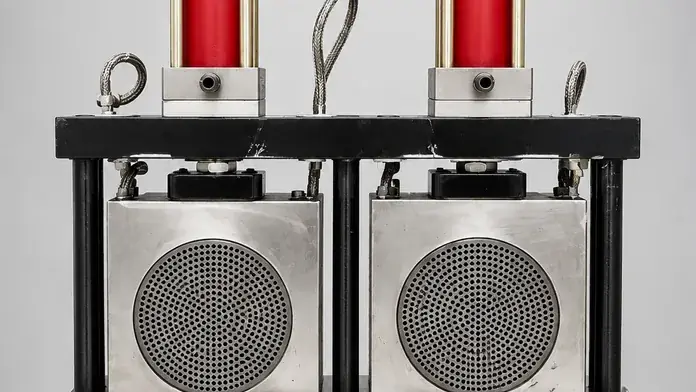
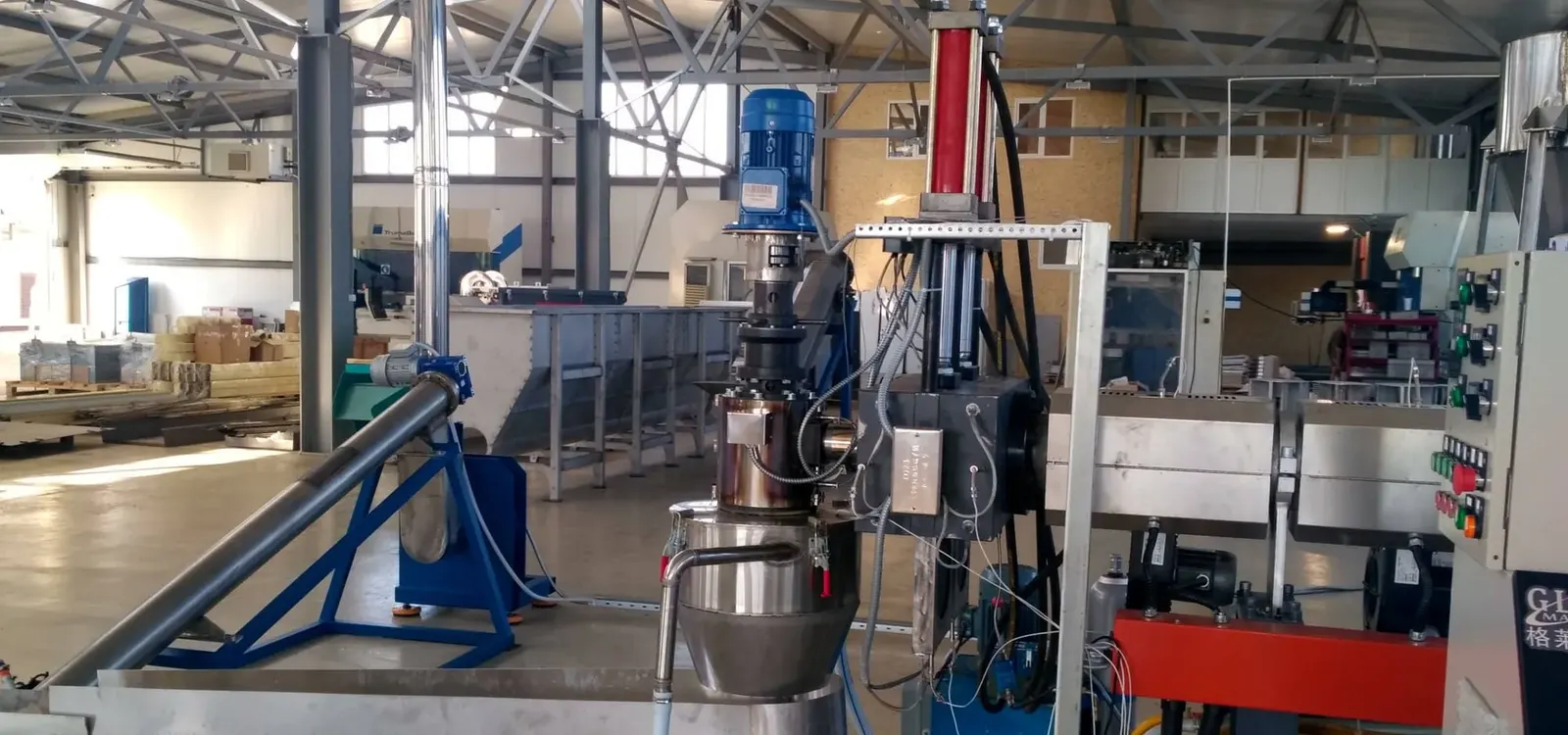
On contaminated feedstock, manual screen changes mean frequent stops, material losses at restarts and unstable pressure. The continuous slide-plate screen changer works with four filter elements 200–250 mm in diameter. The melt passes through two screened windows at the same time, while two more windows with pre-installed screens wait their turn. Melt pressure sensors automatically signal the hydraulic unit, and a hydraulic cylinder swaps each window with a used screen for one with a clean screen, one at a time, in 2–3 seconds. Melt flow is not interrupted.
The screen changer comes in two versions: with 200 mm windows for extruders with a screw diameter of 100–135 mm, and with 250 mm windows for 135–160 mm screws. The set includes a hydraulic unit with two hydraulic cylinders, heaters, a melt pressure sensor, a cabinet with heating controls and starting equipment, and a mobile support platform.
Pelletizing head, die plates and knives
If the pellets come out in different sizes or stick together, the cause may be a worn die plate, worn knives or the head type. For polyolefins (HDPE, LDPE, PP), Himmash supplies a hot die-face pelletizing head with an output of up to 400 kg/h and an adjustable cutter shaft speed of up to 2,800 rpm. For high-MFI polymers, strand pelletizing heads are used. Die plates for all types of heads and squeezers are made of high-strength steels hardened to 48–54 HRC; cutting units are self-centering two-knife, three-knife and four-knife designs.
Mechanical parts: thrust bearing, shafts and rotors
Extruder thrust bearing unit
The extruder screw pushes the melt through the filter and the die plate, and the reaction to this pressure is taken by the thrust bearing. Finer filtration raises the pressure upstream of the filter, and with it the axial load. So after upgrading filtration, check whether the thrust bearing unit has enough capacity.
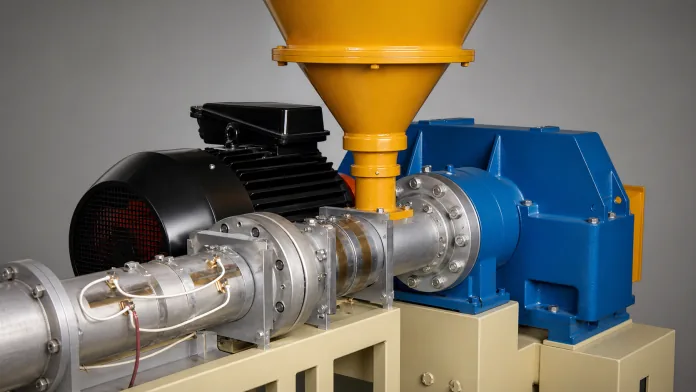
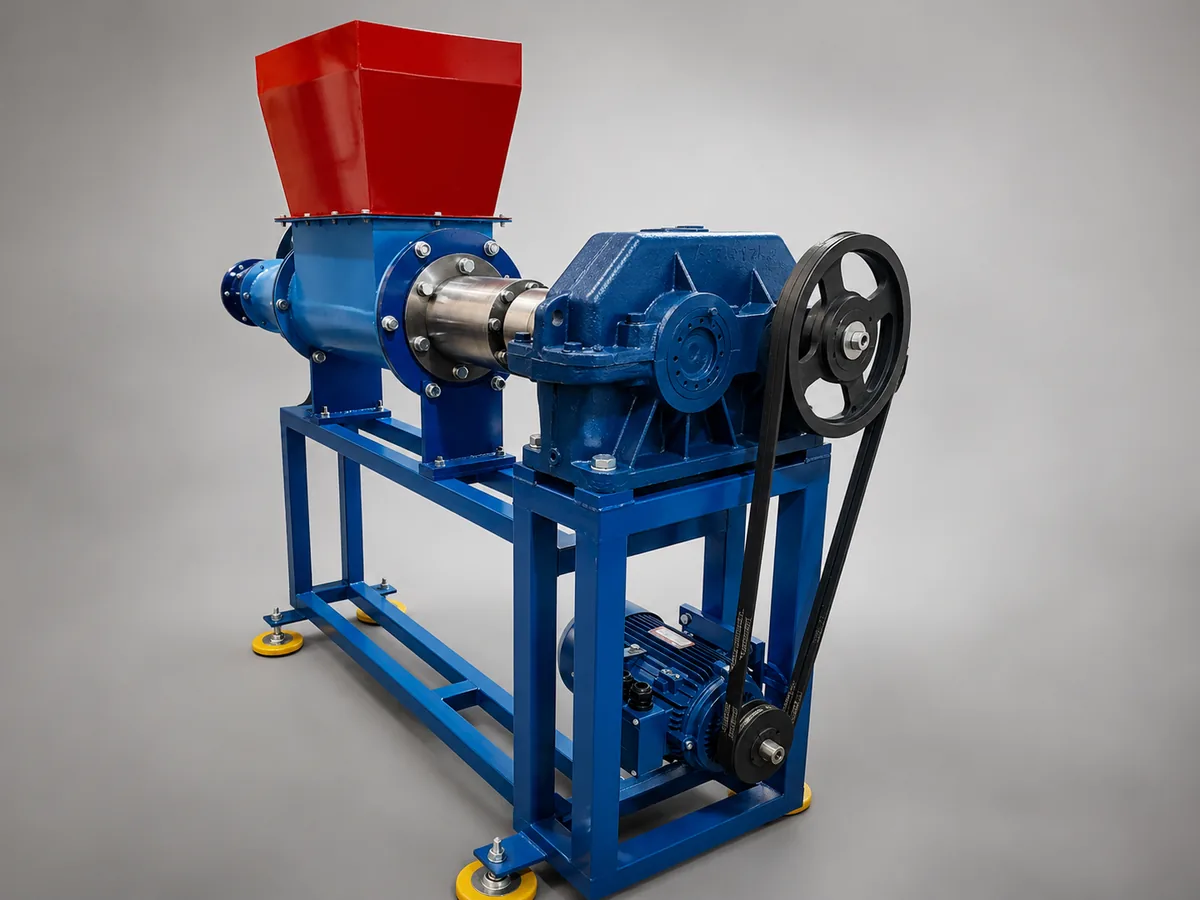
Himmash supplies an extruder thrust bearing unit for RTs-2u-250, -315, -355 and -400 cylindrical gearboxes. The unit was originally developed in the USSR for a domestic gearbox and is compatible with modern extrusion lines. Its design includes a housing with an oil bath, a water cooling jacket, and thrust and radial bearings equivalent to imported ones. On request, non-Chinese bearings are installed, with supporting documents and photo and video records. The unit is mounted on a separate pad of the extruder frame next to the gearbox. If the line has a gearbox of another make, including a Chinese one, an engineer checks separately whether the unit is applicable and what modifications are needed. The price depends on the gearbox model and the extruder screw diameter, so this data is needed as early as the first discussion.
Friction washer shafts and centrifuge rotors
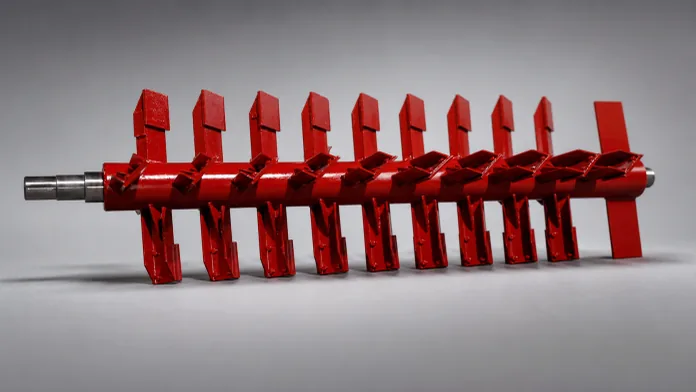
An unbalanced shaft in a high-speed washer or an unbalanced centrifuge rotor causes vibration and wrecks the bearings and their seats. Himmash manufactures shafts, rotors and screws, including stainless steel versions, to customer drawings or to its own designs, and adapts the geometry to fit existing equipment. All units undergo high-precision dynamic balancing, seal seats are hardened to 45–50 HRC, and blade liners are made of heat-treated high-strength steel and fastened with stainless steel hardware.
Water: a closed loop instead of constant discharge
If the washing section runs on once-through water, the upgrade should also include water treatment. The T-5000 system treats washing line wastewater and returns the water to the production cycle up to 20 times. Its capacity is 3 to 10 m³/h; treatment methods are electroflotation, electrocoagulation, electrolysis, electrodialysis, sorption and mechanical filtration. The system is installed in the shop or as a separate container unit, occupies 35 m² and is run by one person.
How to plan an upgrade and what to prepare
The work goes in three steps. First, an engineer reviews your feedstock, volumes and existing equipment free of charge and drafts a preliminary concept. Next, the units are selected or designed, the configuration is worked out, and we show what can be improved on the current line. In the third step, the equipment is manufactured and delivered, installed and commissioned, and we help you reach planned capacity.
For the first conversation, it helps to have:
- extruder make and model and screw diameter, which determines the screen changer version;
- extruder gearbox make;
- current and target output in kg/h;
- feedstock type and origin, photos;
- photos of defective pellets and used filter screens;
- washing section configuration and photos of the units;
- water consumption and wastewater discharge layout.
An upgrade is more cost-effective when it goes from cause to effect: first washing, then degassing and filtration, then the mechanical parts and water. With this approach, the line is not replaced entirely: only the units that limit pellet quality and stable operation are replaced or improved.